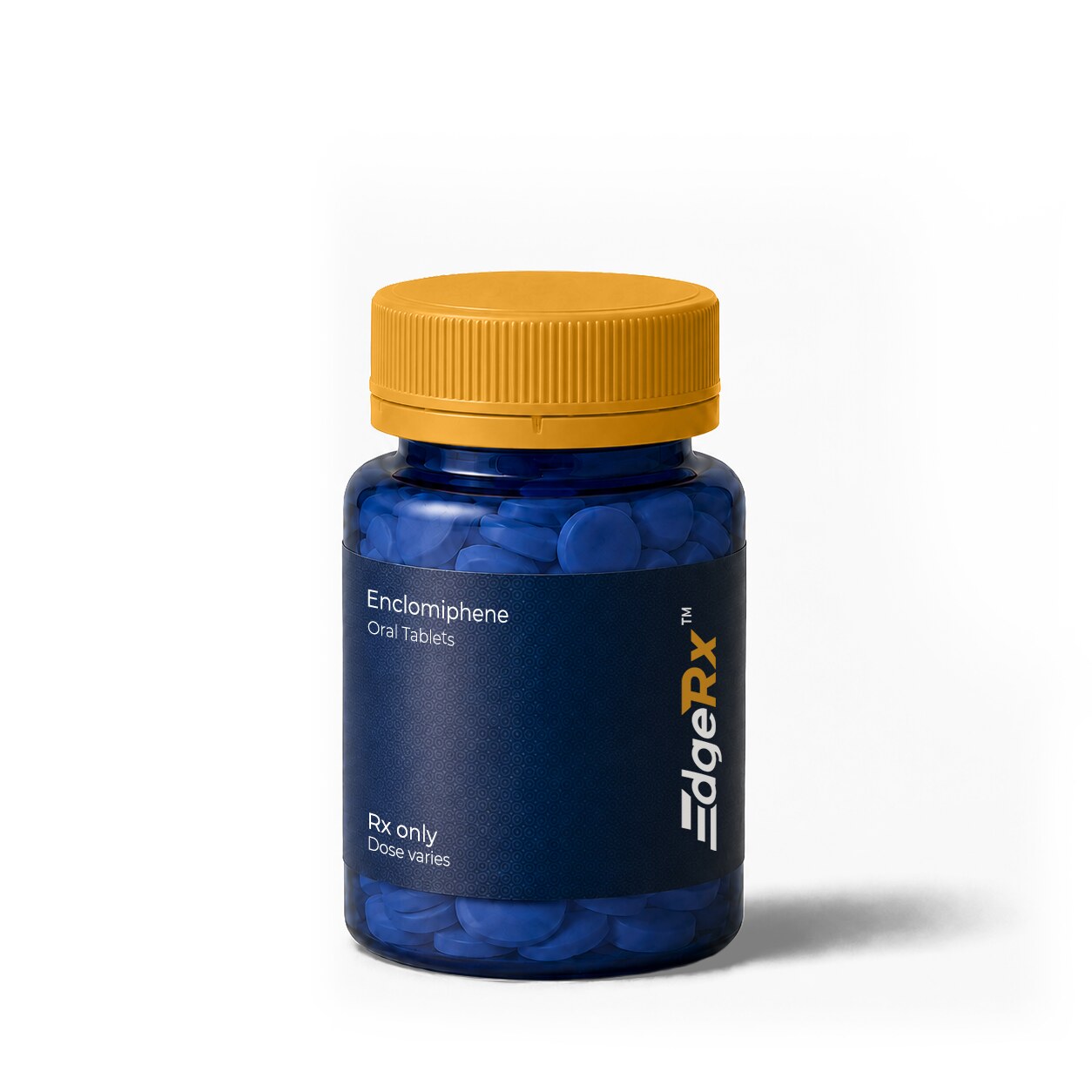
12.5 mg flex-dose tablet · 11 per month
Enclomiphene
For the men whose testosterone has dropped — who want to raise it without starting testosterone replacement.
- Raises testosterone by driving your body's own production
- A daily tablet — no injections, no testosterone gels
- Keeps fertility and testicular function intact
Standard price $89/mo
Next: brief medical assessment, then physician review. Usually within 24 hours.
Questions? Call us at (908) 516-EDGE.

US board-certified physician review
A board-certified physician builds your protocol.
US-licensed 503A pharmacy
Pharmaceutical-grade purity, prescribed by your physician.
Shipped discreetly to your door
Subscription billed monthly. Cancel anytime.
How Enclomiphene works
Enclomiphene is a selective estrogen receptor modulator. It signals the brain to increase the hormones that drive your body's own testosterone production — rather than replacing testosterone from outside.
Enclomiphene is a selective estrogen receptor modulator — a SERM. It is one of the two isomers that make up clomiphene, isolated on its own. It works in the brain: the hypothalamus and pituitary normally read circulating estrogen as a sign that testosterone is sufficient and dial back the hormones that drive testosterone production. Enclomiphene blocks that estrogen signal, so the brain increases its output of luteinizing hormone (LH) and follicle-stimulating hormone (FSH) — the hormones that tell the testes to produce testosterone.
Because it works on that signal, enclomiphene raises the body's own testosterone rather than supplying testosterone from outside. This is the difference from testosterone replacement. Replacement therapy adds testosterone directly, which the brain reads as more than enough and responds to by reducing its own LH and FSH — and with them, natural testosterone production and the testicular function tied to fertility. Enclomiphene moves the other way: it raises LH and FSH, so the testes stay active and sperm production is preserved. It does not contain testosterone itself; it is a compound that changes how the body's own hormone signaling runs.
Enclomiphene works when low testosterone comes from the signal — secondary hypogonadism, where the brain's drive to the testes has fallen off. It will not raise testosterone when the testes themselves cannot respond, the pattern seen in primary hypogonadism, where LH is already high. Bloodwork is how your physician tells the difference. Your physician confirms enclomiphene is appropriate for you from your labs and history, and builds the protocol around what your results show.
Why Enclomiphene
Low testosterone in your 40s and 50s shows up as fatigue, lower drive, slower recovery, and a flatter mood — and it sits in an awkward gap. A standard care visit often runs a single testosterone number and either treats it as normal or moves straight to testosterone replacement. The option of raising your own production first is rarely the one put in front of you.
Most men in their 40s and 50s read about enclomiphene, often through a podcast or a long thread on testosterone, well before they find a physician who will prescribe it. EdgeRx closes that gap — the same compound, a US-licensed 503A compounding pharmacy, US board-certified physician review, and the bloodwork the protocol actually depends on.
What to expect
Enclomiphene clears the body quickly, so the rise in LH and FSH it drives begins within the first days on the protocol. The testosterone change behind it builds over the following weeks, and the difference men tend to notice — steadier energy, drive, and recovery — tracks that rise rather than arriving overnight. Your physician rechecks your bloodwork to confirm testosterone has moved into a healthier range and to adjust the dose. Enclomiphene is run as ongoing support, not a short course.
- Testosterone raised into a healthier range, from your body's own production
- Energy, drive, and recovery that track the hormone change
- Fertility and testicular function kept intact
- A daily tablet, with bloodwork your physician reviews
What Enclomiphene supports
Your own testosterone
Enclomiphene raises testosterone by increasing LH and FSH, the hormones that signal the testes to produce it. The testosterone comes from your own body rather than from an outside dose — the protocol restores the signal rather than replacing the hormone.
Fertility preserved
LH and FSH are also the hormones involved in sperm production. Because enclomiphene raises them rather than suppressing them, it does not shut down fertility the way testosterone replacement can — which is why it is often the protocol chosen by men who want to keep that option open.
A cleaner antiestrogen
Clomiphene is a mix of two isomers. Enclomiphene is the trans-isomer isolated on its own, which gives a more targeted estrogen-receptor effect with less of the estrogenic activity of the other isomer. In men, that is associated with a lower risk of the mood and estrogen-related effects sometimes seen with clomiphene.
Dosing guided by bloodwork
Enclomiphene is supplied as a flex-dose tablet, so your physician can adjust the dose precisely as your follow-up labs come back. The protocol is set and revised against your testosterone, LH, FSH, and estradiol results, not against a fixed schedule.
How you take it
The routine
You take enclomiphene as a tablet, swallowed once daily. Your physician sets the dose and the weekly schedule — enclomiphene is commonly taken five days on and two days off, though the schedule is your physician's decision. No injections, no gels, no clinic visit.
Starting dose
Your physician sets your starting dose from your bloodwork and medical history. Enclomiphene is supplied as a flex-dose tablet, so the dose can be adjusted precisely as your follow-up labs come back. Most men start at a conservative dose and adjust at a check-in. Enclomiphene is titrated to your hormone response — your physician owns the dose decision.
Schedule
Enclomiphene is run as an ongoing protocol rather than a short course, and it is reviewed against your bloodwork. Your physician rechecks your testosterone, LH, FSH, and estradiol at intervals and adjusts the dose or schedule based on the results. There is no fixed end date — how long you stay on the protocol is a clinical decision your physician makes with you.
Questions
Start the Enclomiphene protocol.
Brief medical assessment. US board-certified physician review. Shipped from a US-licensed pharmacy.
See If You QualifyEnclomiphene is a compounded medication prepared by a US-licensed 503A compounding pharmacy under FDA-regulated quality standards. Compounded medications are not FDA-approved as finished products. A prescription is determined by a US board-certified physician after a brief medical assessment, and not all patients are eligible. Enclomiphene raises the body's own testosterone production and is not effective for low testosterone caused by primary testicular failure. It should not be used by anyone with a known allergy to its components; men with a history of eye conditions, mood disorders, or liver conditions require physician evaluation first. Your physician reviews your full medical history and bloodwork before prescribing.