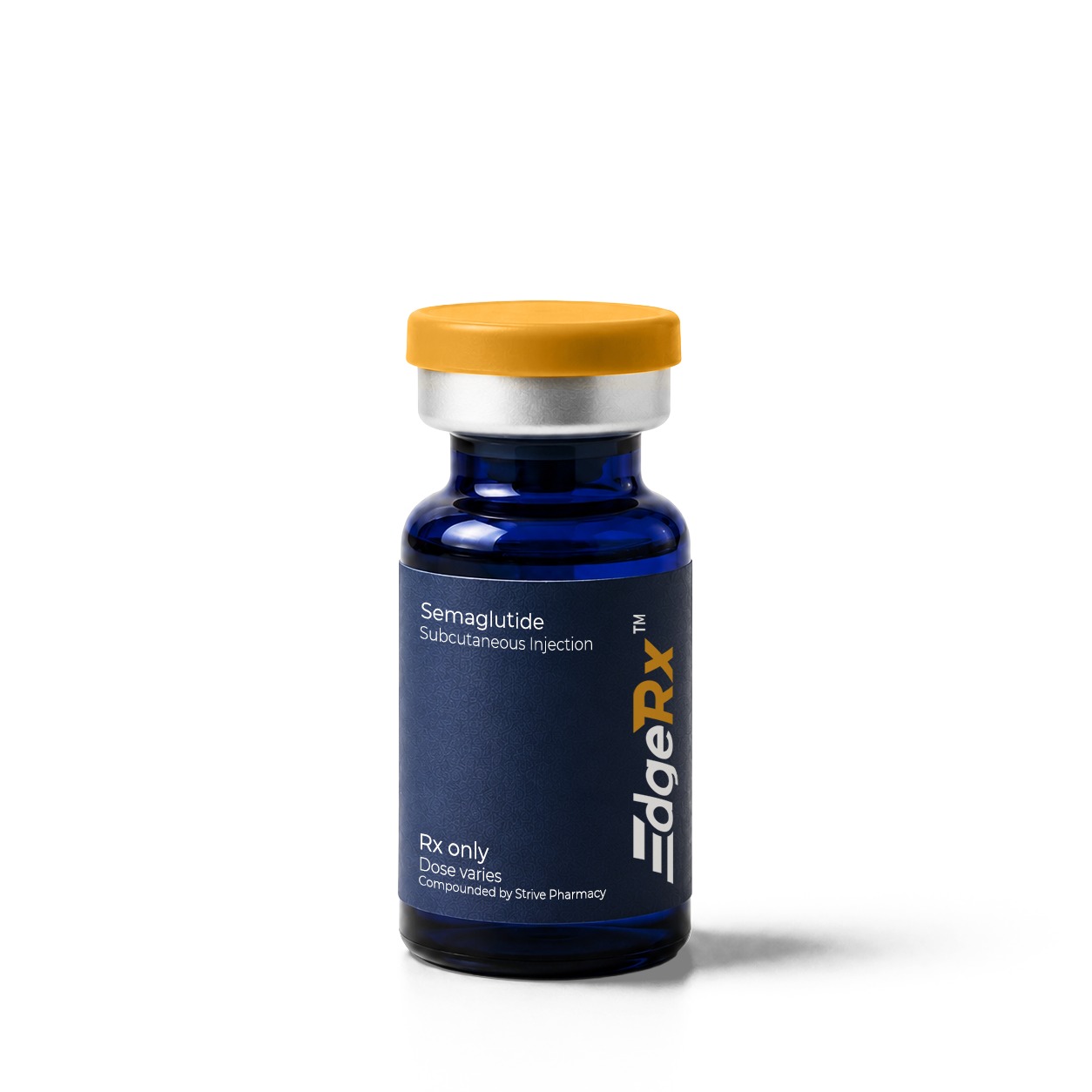
Semaglutide 5 mg/mL with glycine + B12 · 1-month supply
Semaglutide Injection
For the men who want fat loss and an appetite reset — without watching hard-won muscle go with it.
- Lower appetite and fewer cravings
- Fat loss, formulated to protect muscle
- A once-weekly injection, not a daily routine
Next: brief medical assessment, then physician review. Usually within 24 hours.
Questions? Call us at (908) 516-EDGE.

US board-certified physician review
A board-certified physician builds your protocol.
US-licensed 503A pharmacy
Pharmaceutical-grade purity, prescribed by your physician.
Shipped discreetly to your door
Subscription billed monthly. Cancel anytime.
How Semaglutide works
Semaglutide is a GLP-1 receptor agonist — it acts on the brain's appetite signals and the hormones that regulate blood sugar.
Semaglutide is a GLP-1 analog — a close structural match to glucagon-like peptide-1 (GLP-1), an incretin hormone the body releases naturally after eating. By activating the GLP-1 receptor, semaglutide increases insulin production, lowers glucagon secretion, and acts on the regions of the brain that regulate appetite and food intake.
The GLP-1 the body produces on its own lasts only minutes. A small structural change to the semaglutide molecule extends that to weeks, which is what makes a once-weekly protocol possible. Semaglutide is not insulin and not a stimulant — it works through the body's own appetite and glucose-regulation systems rather than overriding them.
EdgeRx's semaglutide is compounded with two deliberate additions. Glycine, an amino acid, is included because research on calorie restriction suggests it may help limit the breakdown of muscle protein during weight loss — preserving lean mass, not just lowering the number on the scale. Vitamin B12 (cyanocobalamin) is included to support nutrient repletion during a period of reduced food intake, and may help reduce the nausea that can accompany the early weeks of a GLP-1 protocol.
Why Semaglutide
Semaglutide became a household name faster than the healthcare system adapted to it. Branded GLP-1s sit behind insurance criteria, supply constraints, and pricing built around a diabetes diagnosis. A standard care visit often will not prescribe one for body composition without meeting those thresholds. Most men researching semaglutide find the compound long before they find a physician who will prescribe and manage it.
EdgeRx closes that gap — a compounded semaglutide protocol, formulated with muscle-preserving glycine and B12, prescribed and titrated by a US board-certified physician who reviews your history first. The protocol is built around male body composition, not a number on a scale.
What to expect
Semaglutide is titrated: your physician starts you at a low dose and steps it up over time, which is how the protocol limits side effects while your body adjusts. Most men notice reduced appetite and fewer cravings within the first few weeks. Changes in body composition build gradually over the months that follow. This is a sustained protocol, not a short course.
- Lower appetite and fewer cravings, without leaning on willpower
- Gradual, sustained fat loss — not a crash
- A protocol built to help you hold onto lean mass, not just lose weight
- Less of the constant background pull toward food
What Semaglutide supports
Appetite regulation
Semaglutide acts on the regions of the brain that regulate appetite and food intake. By engaging the GLP-1 receptor, it can lower hunger signals and reduce cravings — the mechanism behind the smaller appetite most men report.
Blood sugar response
Semaglutide increases glucose-dependent insulin production and lowers glucagon secretion. This supports a steadier blood sugar response to meals, one part of the metabolic picture a physician evaluates alongside body composition.
Muscle preservation
EdgeRx's formulation includes glycine, an amino acid studied for its role in limiting the breakdown of muscle protein during calorie restriction. Holding on to lean mass while losing fat is the body composition outcome that defines a protocol built for men.
Nutrient support
Vitamin B12 is compounded into the protocol to support nutrient repletion during a period of reduced food intake, and may help mitigate the nausea that can accompany the early weeks of GLP-1 use.
How you take it
The routine
A once-weekly subcutaneous injection — given just under the skin, not into muscle, with an insulin-sized needle. It ships as a ready-to-use solution: no mixing and no reconstitution. You draw the dose your physician has set and inject it on the same day each week.
Starting dose
Your physician sets your starting dose and your titration schedule from your medical history. Semaglutide protocols begin low and step up gradually — a deliberate pace that gives your body time to adjust and keeps side effects like nausea manageable. The protocol is supplied in variable-dose vials, so your physician can fine-tune each step without changing the formulation. Most men begin at the lowest dose and move up at physician check-ins.
Schedule
Semaglutide protocols are run as ongoing metabolic support, not as a short course. After the titration period, your physician sets a maintenance approach based on your progress — continuing, holding, or adjusting the dose over time. There is no fixed end date; the schedule is a clinical decision your physician revisits at your check-ins.
Questions
Start the Semaglutide protocol.
Brief medical assessment. US board-certified physician review. Shipped from a US-licensed pharmacy.
See If You QualifySemaglutide Injection is a compounded medication prepared by a US-licensed 503A compounding pharmacy under FDA-regulated quality standards. Compounded medications are not FDA-approved as finished products. A prescription is determined by a US board-certified physician after a brief medical assessment, and not all patients are eligible. Semaglutide should not be used by anyone with a personal or family history of medullary thyroid carcinoma or Multiple Endocrine Neoplasia syndrome type 2, during pregnancy or breastfeeding, or in combination with another GLP-1 medication. It is not insulin and is not a treatment for type 1 diabetes. Tell your physician about any history of pancreatitis, kidney problems, or diabetic retinopathy, and inform any provider before a surgery or procedure involving anesthesia. Your physician reviews your full medical history before prescribing.