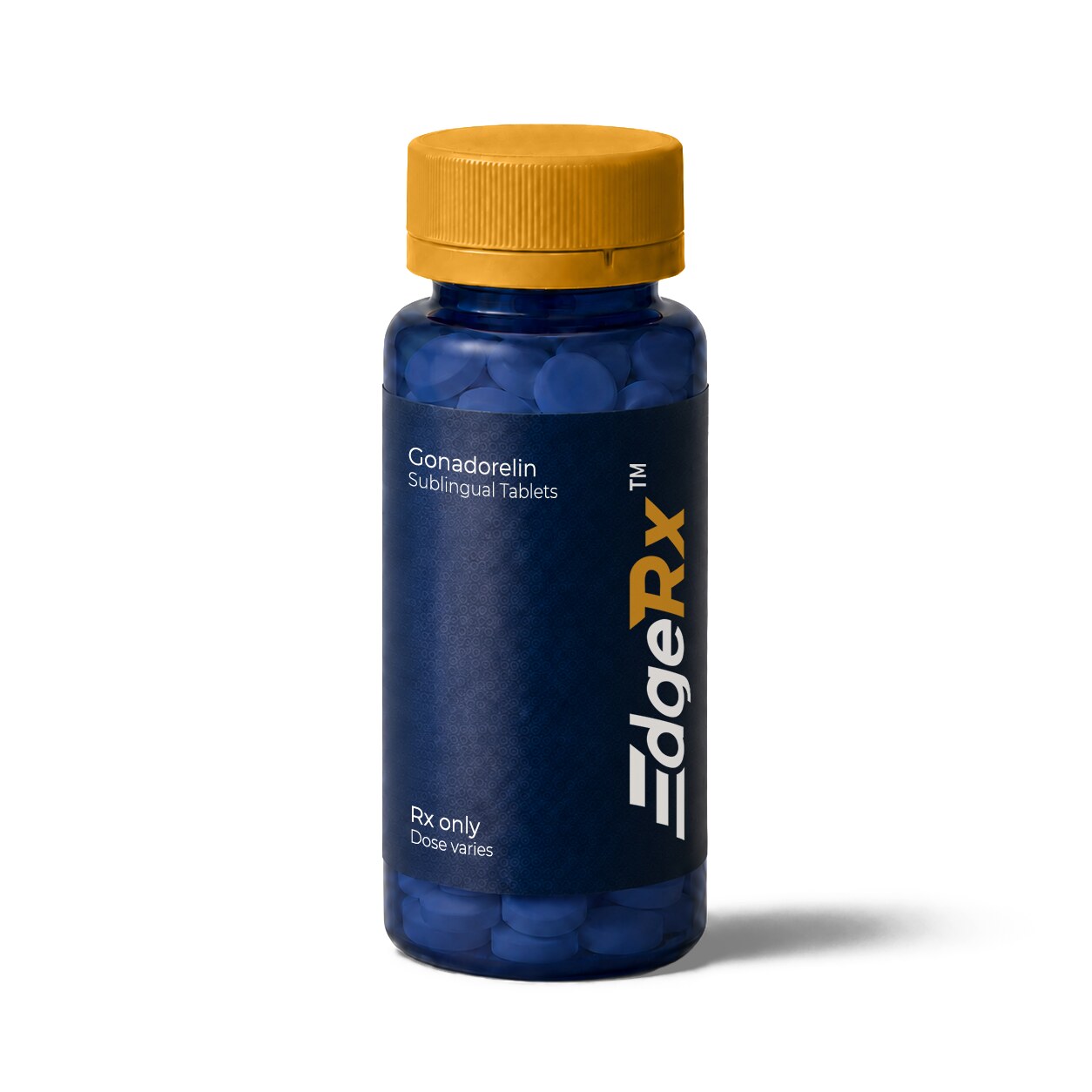
500 mcg per tablet · 12 per month
Gonadorelin Sublingual
For the men whose testosterone has dropped — who want to drive the signal behind it rather than replace the hormone itself.
- Drives your body's own testosterone production at the source
- A sublingual tablet — no injections, no testosterone gels
- Keeps testicular function and fertility intact
Standard price $129/mo
Next: brief medical assessment, then physician review. Usually within 24 hours.
Questions? Call us at (908) 516-EDGE.

US board-certified physician review
A board-certified physician builds your protocol.
US-licensed 503A pharmacy
Pharmaceutical-grade purity, prescribed by your physician.
Shipped discreetly to your door
Subscription billed monthly. Cancel anytime.
How Gonadorelin works
Gonadorelin is a synthetic form of gonadotropin-releasing hormone — the signal the body uses to start its own testosterone production. It prompts the pituitary to release LH and FSH, the hormones that tell the testes to produce testosterone and support sperm production.
Gonadorelin is a synthetic form of gonadotropin-releasing hormone, or GnRH. GnRH is the hormone the hypothalamus uses to signal the pituitary gland — the start of the chain that ends in testosterone. Gonadorelin binds the same GnRH receptors on the pituitary and prompts it to release two hormones: luteinizing hormone (LH) and follicle-stimulating hormone (FSH). LH stimulates the Leydig cells in the testes to produce testosterone; FSH supports the Sertoli cells, which are central to sperm production. Gonadorelin works at the top of that chain, supplying the signal so the testes can do the rest.
Because gonadorelin drives the body's own LH and FSH, the testosterone that follows is the body's own. This is the difference from testosterone replacement. Replacement adds testosterone from outside. The brain reads that as sufficient and dials back its own GnRH, LH, and FSH — and with them, the testicular function and sperm production tied to that signal. Gonadorelin moves the other way: it keeps the LH and FSH signal active, so the testes stay working. It is one reason gonadorelin is used to support the hormone axis in men whose own LH and FSH have fallen off, including men whose signal has been suppressed by testosterone taken from outside.
Gonadorelin supports testosterone when the issue is the signal, not the testes themselves — when the testes can no longer respond, driving LH and FSH will not raise testosterone, and bloodwork is how your physician tells the difference. Because gonadorelin works with the body's own hormone rhythm, protocols are often cycled, with breaks built in, to support natural production. Your physician confirms gonadorelin is appropriate for you from your labs and history, and sets the dose, the schedule, and any cycling around what your results show.
Why Gonadorelin
Low testosterone in your 40s and 50s shows up as fatigue, lower drive, slower recovery, and a flatter mood — and the options a standard care visit puts in front of you are narrow. A single testosterone reading, and either it is called normal or the conversation moves to testosterone replacement. The protocol that drives your own hormone signal first, and keeps testicular function and fertility intact, is rarely the one offered.
Most men in their 40s and 50s read about gonadorelin, often through a podcast or a long thread on testosterone and fertility, well before they find a physician who will prescribe it. EdgeRx closes that gap — the same compound, a US-licensed 503A compounding pharmacy, US board-certified physician review, and the bloodwork the protocol depends on.
What to expect
Gonadorelin acts on the pituitary quickly, so the release of LH and FSH it prompts begins soon after you start the protocol. The testosterone behind it builds over the following weeks, and the difference men tend to notice, in energy and drive, tracks that rise rather than arriving overnight. Your physician rechecks your bloodwork to confirm the protocol is working and to adjust the dose and any cycling. Gonadorelin is run as ongoing, often cycled support, not a short course.
- The body's own LH and FSH signal supported, from the top of the axis
- Testosterone raised from your body's own production
- Testicular function and fertility kept intact
- A sublingual tablet, with bloodwork your physician reviews
What Gonadorelin supports
Signal at the source
Gonadorelin is synthetic GnRH — the hormone at the very start of the chain. It acts directly on the pituitary to release LH and FSH, supporting the hormone axis from its highest point rather than working further downstream.
Testicular function preserved
LH and FSH keep the testes active — driving testosterone production and supporting sperm production. Because gonadorelin raises that signal rather than overriding it, testicular function and fertility are preserved, which is why it is often chosen by men who want to keep that option open.
Production, not replacement
The testosterone gonadorelin raises is made by your own body, prompted by your own LH and FSH. It is not testosterone added from outside the way replacement therapy adds it, so the body's own signaling is supported rather than switched off.
Lab-guided and cycled
Gonadorelin is supplied as a flex-dose tablet, and because it works with the body's own hormone rhythm, protocols are often cycled with breaks. Your physician sets the dose, the schedule, and any cycling against your testosterone, LH, FSH, and sperm parameters.
How you take it
The routine
You take gonadorelin as a sublingual tablet — placed under the tongue, where it dissolves and absorbs directly, on an empty stomach. Gonadorelin is commonly taken three to four times a week, though your physician sets the dose and schedule. No injections, no clinic visit.
Starting dose
Your physician sets your starting dose from your bloodwork and medical history. Gonadorelin is supplied as a flex-dose tablet, so the dose can be adjusted precisely as your follow-up labs come back. Most men start at a conservative dose and adjust at a check-in. Gonadorelin is titrated to your hormone response, and the dose decision is your physician's.
Schedule
Gonadorelin is run as an ongoing protocol rather than a short course, and because it works with the body's own hormone rhythm, it is often cycled, with breaks built in, to support natural production. Your physician rechecks your testosterone, LH, FSH, and sperm parameters at intervals and adjusts the dose, the schedule, and any cycling based on the results. There is no fixed end date — how long you stay on the protocol is a clinical decision your physician makes with you.
Questions
Start the Gonadorelin protocol.
Brief medical assessment. US board-certified physician review. Shipped from a US-licensed pharmacy.
See If You QualifyGonadorelin is a compounded medication prepared by a US-licensed 503A compounding pharmacy under FDA-regulated quality standards. Compounded medications are not FDA-approved as finished products. A prescription is determined by a US board-certified physician after a brief medical assessment, and not all patients are eligible. Gonadorelin supports the body's own testosterone production and is not effective for low testosterone caused by primary testicular failure. It should not be used by anyone with a known allergy to its components. Your physician reviews your full medical history and bloodwork before prescribing.