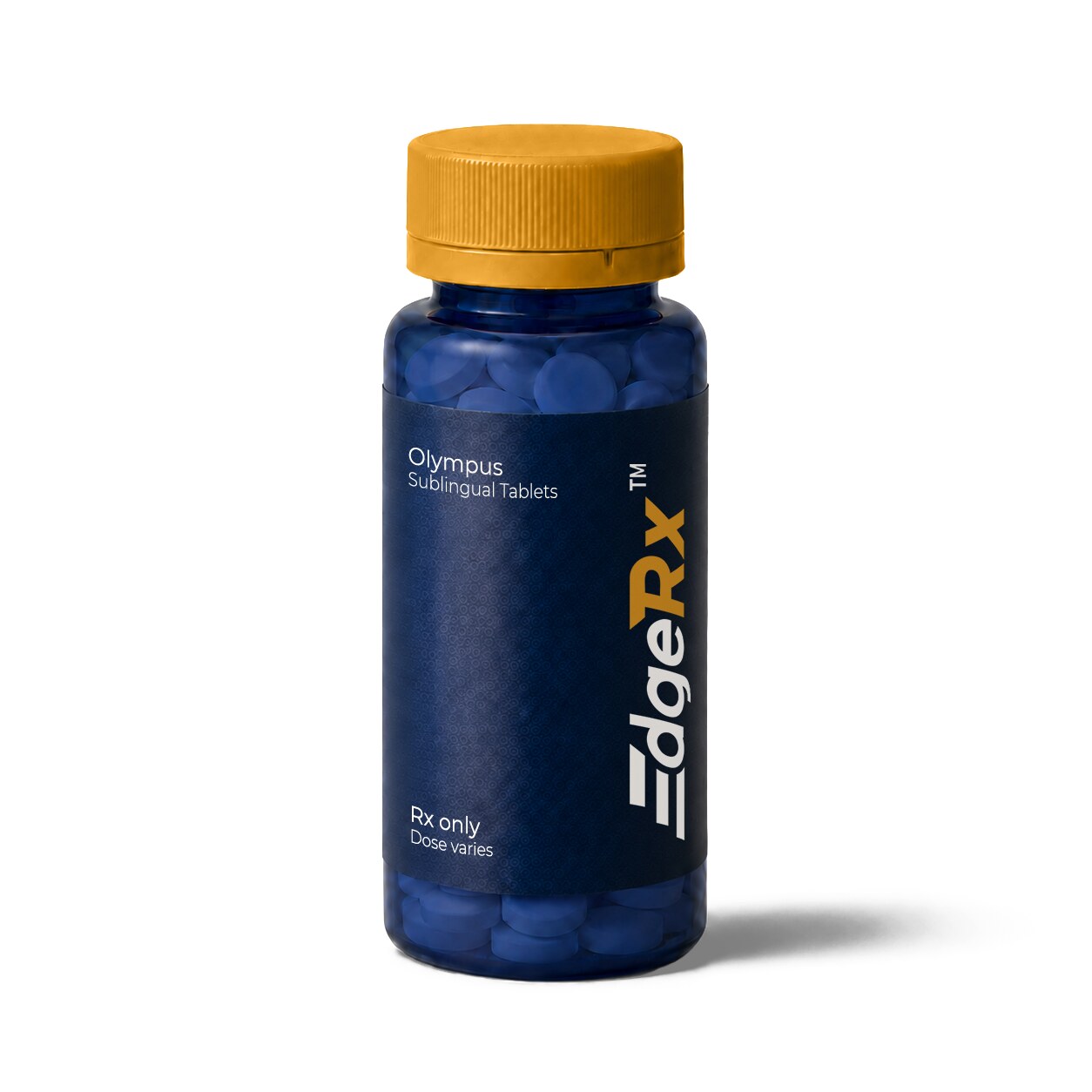
Oxytocin 20 IU + PT-141 1 mg per tablet
10 per month
Olympus
For the men whose interest has faded, who feel the distance that came with it, and who aren't ready to write either off as age.
- Sexual desire and arousal that feel like your own
- A sense of closeness, not only arousal
- Taken as needed. About 30 minutes before
Standard price $129/mo
Next: brief medical assessment, then physician review. Usually within 24 hours.
Questions? Call us at (908) 516-EDGE.

US board-certified physician review
A board-certified physician builds your protocol.
US-licensed 503A pharmacy
Pharmaceutical-grade purity, prescribed by your physician.
Shipped discreetly to your door
Subscription billed monthly. Cancel anytime.
How Olympus works
Olympus pairs two compounds: PT-141, which works on the brain pathways behind sexual desire and arousal, and oxytocin, which supports receptivity and a sense of connection.
Olympus combines two compounds in a single sublingual tablet. The first, PT-141 (bremelanotide), is a melanocortin receptor agonist. It works by stimulating melanocortin receptors in the brain — the receptor pathways involved in modulating sexual arousal and desire. Rather than acting on blood flow, PT-141 works further upstream, on the arousal response itself.
The second compound is oxytocin, a peptide hormone the body produces in the pituitary gland. Oxytocin is associated with receptivity, trust, and the feeling of connection between partners. In the context of sexual function, it is associated with increased sexual receptivity. Where PT-141 acts on desire and arousal, oxytocin works on the relational side of intimacy: the closeness, not only the drive.
Olympus is used as needed, not daily. It is taken ahead of anticipated sexual activity and has a relatively rapid onset. The intent of the protocol is to support desire and connection in the moment they are wanted, rather than to alter the body's day-to-day chemistry. Neither compound is testosterone, and Olympus does not raise or replace your testosterone. Your physician confirms it is appropriate for you and sets how it fits your history.
Why Olympus
Low sexual desire sits in an awkward gap. It is more clinical than the libido and "testosterone-booster" supplements on the shelf can credibly address, more specific than the erectile-function medications built for blood flow rather than desire itself, and more personal than a conversation a standard care visit rarely makes room for.
Most men in their 40s and 50s research compounds like these — often after a podcast or a long thread — well before they find a physician who will prescribe them. EdgeRx closes that gap: Olympus pairs PT-141 and oxytocin in one physician-prescribed sublingual tablet, compounded by a US-licensed 503A pharmacy and reviewed by a board-certified physician.
What to expect
Olympus is taken as needed, not on a daily schedule, and there is no loading period — nothing builds up over weeks. Taken about 30 minutes before sexual activity, it works on desire, arousal, and receptivity over the following hours. Most men can judge how it works for them within the first one or two times they use it.
- A genuine return of interest and arousal
- A sense of closeness alongside the desire
- An option you reach for only when you want it
- An effect felt the same session, not weeks down the line
What Olympus supports
Sexual desire and arousal
PT-141, one of the two compounds in Olympus, is a melanocortin receptor agonist that acts on receptor pathways in the brain involved in sexual arousal and desire. It may enhance sexual desire and arousal by working on these central pathways. Research has studied bremelanotide for its effect on low sexual desire.
Connection and closeness
Oxytocin, the second compound in Olympus, is associated with receptivity, trust, and the sense of connection between partners. It may support the relational side of intimacy — the closeness that desire alone does not address. Research has studied oxytocin's role in receptivity and bonding.
As-needed dosing
Olympus is taken ahead of anticipated sexual activity rather than on a daily schedule. As-needed administration is associated with flexibility — the protocol is used when it is wanted, which supports spontaneity rather than a fixed daily routine.
A combination protocol
Olympus pairs two compounds in a single sublingual tablet, each acting on a different part of the experience: PT-141 on desire and arousal, and oxytocin on receptivity and connection. It is a combination protocol rather than a single-compound one, compounded together by a US-licensed pharmacy.
How you take it
The routine
Let one tablet dissolve under your tongue, taken about 30 minutes before sexual activity, as your physician directs. Olympus is used as needed, not on a daily schedule — there is nothing to take between encounters. No injection and no clinic visit; the tablet dissolves on its own.
Starting dose
Your physician sets your starting dose based on your history and goals. Olympus is compounded as a sublingual flex-dose tablet, which can be taken as a fraction of a tablet — a quarter, a half, or a whole — so the dose can be adjusted without changing the prescription. Most men start conservatively and adjust at a check-in if needed. Olympus is titrated to your response, and your physician owns the dose decision.
Storage
Store Olympus as directed on your pharmacy label. Storage and beyond-use dating are confirmed by the compounding pharmacy. A month's supply covers a month of as-needed use.
Frequency
Olympus is used as needed, ahead of sexual activity — not daily and not in cycles. It is generally taken no more than once in a 24-hour period. Your physician sets the right frequency for you, including any daily or monthly limit, and reviews it at your check-ins.
Questions
Start the Olympus protocol.
Brief medical assessment. US board-certified physician review. Shipped from a US-licensed pharmacy.
See If You QualifyOlympus is a compounded medication prepared by a US-licensed 503A compounding pharmacy under FDA-regulated quality standards. Compounded medications are not FDA-approved as finished products. A prescription is determined by a US board-certified physician after a brief medical assessment, and not all patients are eligible. The PT-141 in Olympus can raise blood pressure and is not appropriate for men with uncontrolled high blood pressure or significant cardiovascular disease — disclose any blood-pressure or heart condition during the medical assessment.